Industry and energy
Chemical industry process areas, industrial wastewater and the collection of contaminated stormwater. The joint's chemical resistance equals the pipe's.

Applications
Wherever the pipe carries something that must not end up in the soil or groundwater, or where the joint must last as long as the pipe.
Municipal networks
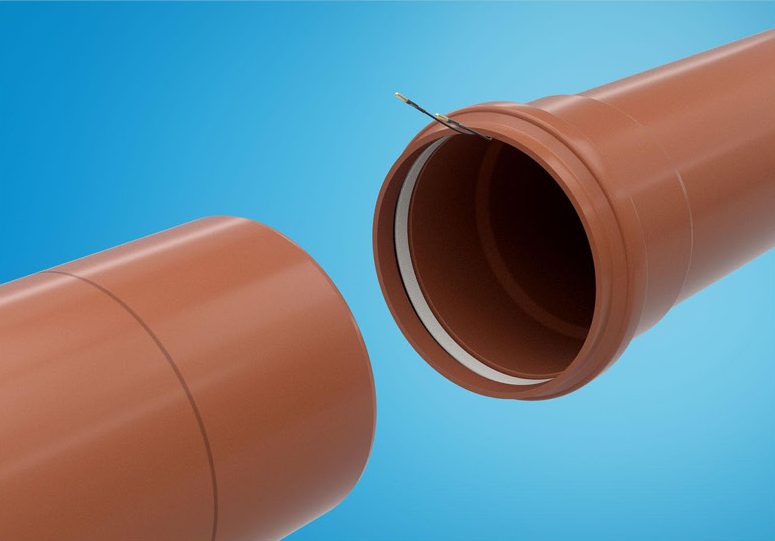
The IP-PLUS ring was developed for welding the socket joints of PP and PE plastic pipes. The ring installs into the pipe system's own socket, so there are two requirements: the socket must have a sealing chamber, and the pipe material must be polypropylene or polyethylene.
In municipal networks a welded joint solves two chronic problems: infiltration water that loads treatment plants, and tree roots that penetrate rubber-sealed joints. In a welded network neither is possible.
Socket dimensions and construction vary between manufacturers, so compatibility is always confirmed for the specific pipe system. Tell us which pipe system is involved and we will go through it.
Hazardous liquids
In Germany the AwSV ordinance (2017) defines the sites where a rubber seal is not an accepted joint for plastic pipes and a stronger, more reliable jointing method is required. In practice that means welding. The same direction is visible across Europe.
Chemical industry process areas, industrial wastewater and the collection of contaminated stormwater. The joint's chemical resistance equals the pipe's.
Petrol stations, airports, ports and logistics centres are the most typical AwSV sites, where oils and chemicals travel with stormwater.
Slurries, silage effluents and biogas plant fractions (JGS sites). Organic loads demand tight, welded lines.
In Finland the Environmental Protection Act (527/2014), the Water Act (587/2011) and building regulations require wastewater systems to be tight and reliable but do not name a jointing technique. In practice, groundwater zones and chemical-handling areas require welded or specially sealed joints for risk management. That is exactly what the IP-PLUS system is made for.
Groundwater zones
In groundwater zones a leaking sewer line is environmental damage before it is even detected. A welded network removes joints from the risk list: every seam is a material bond that can be proven tight by pressure testing (EN 1610).
Welding cycle data can be documented per joint, keeping the quality control of the whole line traceable on site and for years afterwards.
And more
Some welding units also weld conventional PE-HD and PP electrofusion couplings in sizes DN 110–2000, so one unit covers all the joints on site.
With the PEPP welding ring a new PP line is welded to an existing PE network. Especially valuable in renovation projects.
Ring sizes extend up to DN 2000. Solutions for large diameters and special sites are dimensioned project by project.
Tell us the application and we will assess whether a welded joint fits.