Chemical and mechanical durability
The joint has the same chemical and thermal resistance as the PP or PE pipe. No seal ageing, no embrittlement at the interface.

IP-PLUS® welding ring
Beweldo manufactures IP-PLUS welding rings that turn PP and PE socket joints into material bonds without special components, in minutes.
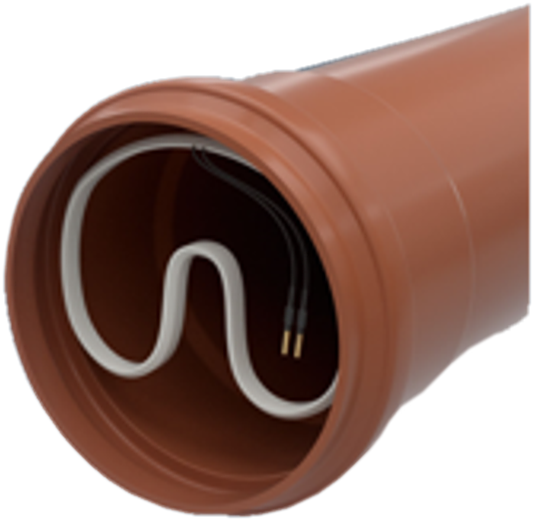
What the welding ring is
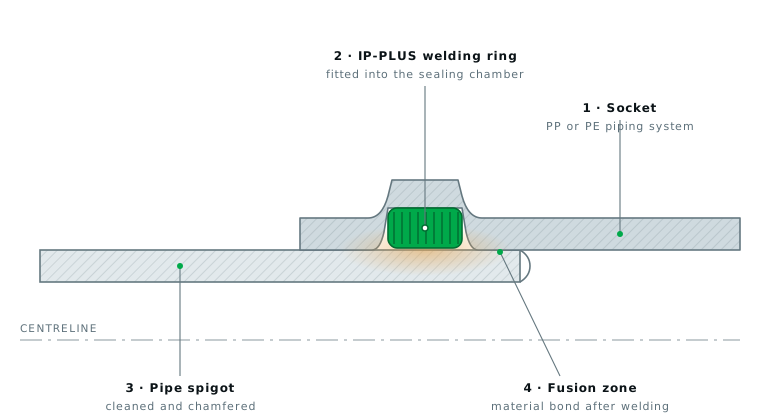
The IP-PLUS welding ring is a preformed, airtight-packed ring with a copper wire winding around its body. The ring is pressed into the socket's sealing chamber in place of the rubber seal, the pipe spigot is pushed home and the welding unit feeds the ring with a defined welding voltage.
The winding distributes heat evenly around the full circumference. The ring's controlled expansion generates the joining pressure by itself and bridges even the large dimensional tolerances of pipe systems. The result is a material bond with the same chemical and thermal resistance as the pipe.
Why a welded joint
Rubber-ring connections age, harden and fail under ground movement and chemical exposure. A welded joint behaves like the pipe itself for its entire service life.
The joint has the same chemical and thermal resistance as the PP or PE pipe. No seal ageing, no embrittlement at the interface.
A welded socket joint withstands pressures of up to 12 bar. Even in gravity systems this provides a safety margin against blockages and pressure surges.
A few work steps and a short welding cycle: a 160 mm joint is completed in under ten minutes including preparation.
The ring installs into the pipe system's own socket. No separate electrofusion couplings or adapters are needed.
A fully welded joint does not leak into the environment and gives tree roots no path into the pipe. That is why welded joints are required in practice in groundwater zones and chemical-handling areas.
The new IP-PLUS PEPP ring joins polyethylene to polypropylene by welding, so a new line can also connect to the infrastructure already in the ground.
Tested and certified
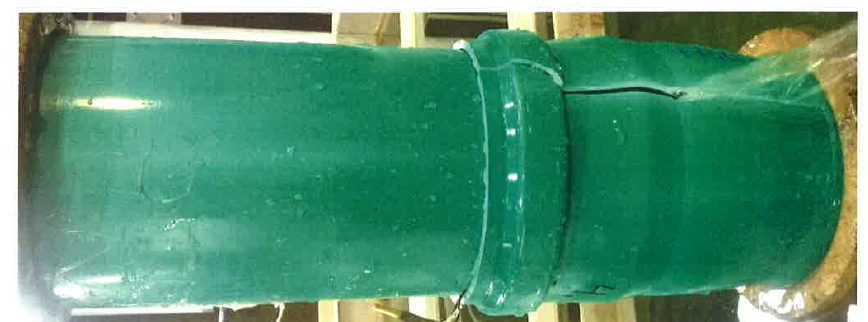
The IP-PLUS joint holds a German DIBT approval (a procedure equivalent to CE approval), with tightness verified under compression and bending to EN 14758-1 and EN ISO 13259 at the accredited MFPA test laboratory.
Our own testing at VTT in Finland confirms the result: a pressure test at 80 °C for 140 hours, end-supported (EN ISO 1167, type B), and burst-pressure tests at 20 °C.
The system is not new. IP-PLUS rings have been delivered to the German market for more than ten years, under Europe's strictest joint requirements.
On site
The work steps are the same regardless of size. The welding unit controls voltage and time automatically, so the installer's job is preparation and assembly.
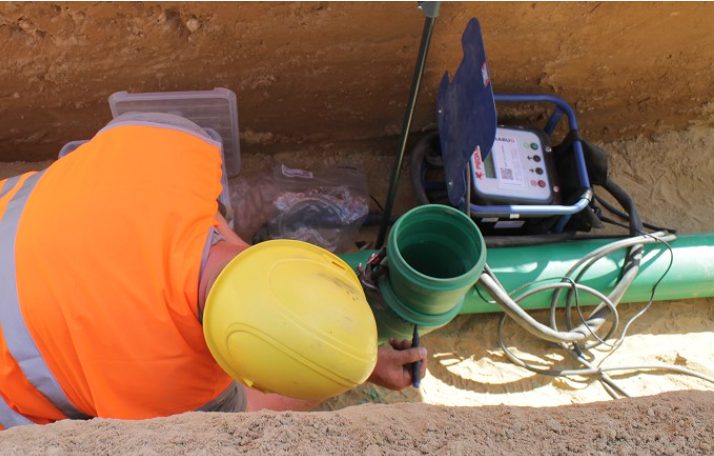
The pipe end is cut square, chamfered and cleaned. The socket's sealing chamber is cleaned of loose dirt.
The welding ring is pressed into the sealing chamber in place of the rubber seal. The ring is preformed and seats as it is.
The pipe spigot is pushed into the socket up to the insertion mark.
The welding unit is connected to the ring's terminals and the cycle is started. The unit supervises voltage and time by itself.
The joint cools unloaded for the specified time, after which the line is ready to be backfilled.
Applications
Underground PP and PE sewer systems whose sockets have a sealing chamber.
Sites where a rubber seal is not enough: petrol stations, airports, industry, biogas and agriculture.
Sites where tightness in practice demands a welded joint because of environmental risk.
Welding of PE-HD and PP couplings with the same equipment: one unit covers the whole site.
Tell us about the project and pipe system, and we will specify the right ring sizes and equipment.