Heat
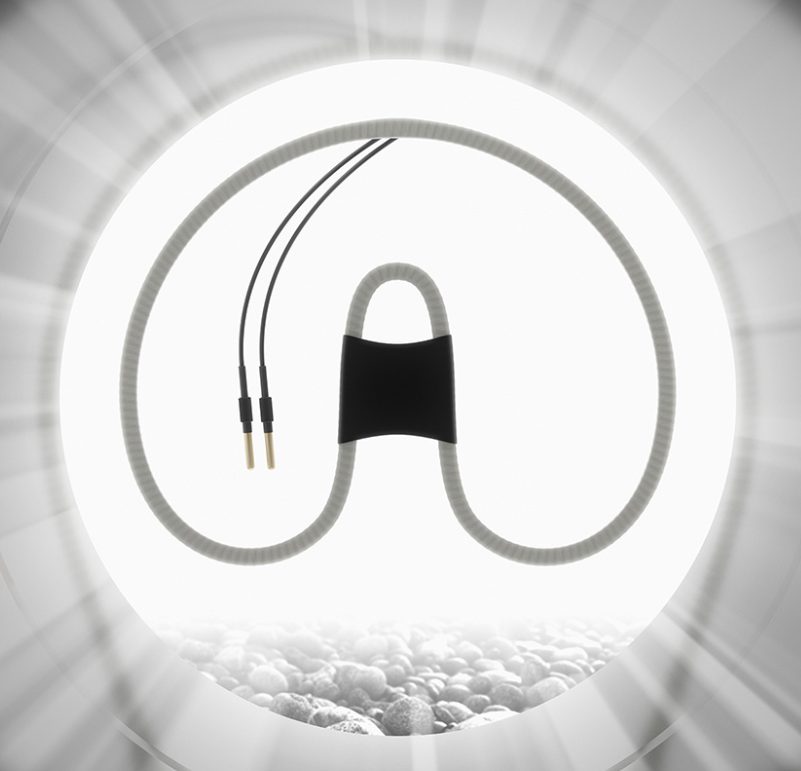
The copper winding converts the welding unit's voltage into heat and distributes it evenly around the ring's circumference.

Product
A preformed ring that turns an ordinary socket joint into a welded material bond. One component, one work step.
Structure
The ring body is preformed so that it seats in the socket's sealing chamber without separate tools. Around the body runs a copper wire winding that acts as the heating element and distributes the welding heat evenly around the full circumference of the joint.
The ring's coating is chosen to match the pipe system's material: polypropylene (PP) or polyethylene (PE). The melting material is the same as in the pipe and socket, so the result is a true material bond rather than a mere seal.
Rings are delivered in airtight packaging that protects the welding surfaces from dirt and moisture during storage and transport to site.
Working principle
A welded joint needs three things: sufficient heat, sufficient joining pressure and controlled cooling. In the IP-PLUS ring these arise without separate clamps or heating elements.
The copper winding converts the welding unit's voltage into heat and distributes it evenly around the ring's circumference.
As it heats up, the ring expands in a controlled way and fills the sealing chamber. The expansion generates the required joining pressure by itself.
The same expansion bridges the dimensional variation of pipe systems, so the joint succeeds even in looser sockets.
Technical data
| Intended use | Welding of socket joints in PP and PE pipe systems, and welding of electrofusion couplings |
|---|---|
| Body coating | Polypropylene (PP) or polyethylene (PE) to match the pipe system material |
| Heating element | Copper wire winding around the ring body |
| Installation position | Socket sealing chamber, in place of the rubber seal |
| Joining pressure | Generated by the ring's controlled expansion, no separate clamps needed |
| Welding method | Multi-Voltage: the welding unit defines and adjusts the voltage automatically |
| Welding time | DN 160: under 10 min incl. preparation |
| Ring sizes | DN 110–2000 |
| Pressure resistance | up to 12 bar |
| Operating temperature | −20…+90 °C |
| Certification | DIBT approval (Germany) · EN 14758-1 · EN ISO 13259 |
| Delivery form | Preformed, airtight-packed |
| Manufactured in | Karstula, Finland |
Sizes and compatibility
The ring is selected by the pipe system's material and nominal diameter. Compatibility is always confirmed for the specific pipe system.
| Pipe material | Polypropylene (PP) or polyethylene (PE) |
|---|---|
| Socket construction | The socket must have a sealing chamber for the ring to replace the rubber seal |
| Ring sizes | DN 110–2000 |
| Confirming compatibility | Per pipe system, because socket dimensions and construction vary between manufacturers |
Note: the welding ring installs into the pipe system's own socket. The socket must have a sealing chamber and standard-compliant dimensions. When in doubt, send us the pipe system details and we will verify compatibility.
Quality and approvals
The IP-PLUS joint holds a German DIBT approval (a national procedure equivalent to CE approval), with tightness demonstrated under compression and bending to EN 14758-1 and EN ISO 13259. The tests were performed by the accredited German MFPA laboratory.
We have also had the joints tested at VTT in Finland: a pressure test at 80 °C, end-supported, for 140 hours (EN ISO 1167, type B) and burst-pressure tests at 20 °C. The result is unambiguous: the joint is as strong as the pipe.
The strongest evidence comes from the field: Ostendorf, Germany's market leader in plastic indoor and underground sewers, uses IP-PLUS welding rings for the welded joints of its KG2000 pipe system.
PEPP ring
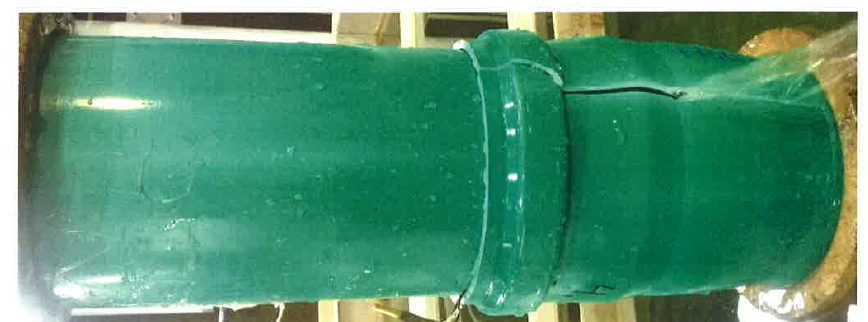
PE and PP do not traditionally weld to each other. Our newest innovation, the IP-PLUS PEPP welding ring, was developed for exactly this: joining polyethylene and polypropylene pipes by welding, without mechanical fittings.
In practice this means that in renovation projects old and new pipe materials no longer meet at a rubber-sealed joint: the material interface is welded too.
FAQ
The ring installs into the socket's sealing chamber, so the socket must have a sealing chamber and the pipe material must be PP or PE. Socket dimensions and construction vary between manufacturers, so compatibility cannot be inferred from the material alone. Send us the pipe system details and we will confirm.
A welding ring and a welding unit. The unit identifies the welding parameters and controls voltage and time automatically. No separate clamps, heating elements or adapters are needed. Read more on the system page.
Yes, provided the joint surfaces are clean and dry and there is room to work. Moisture, sand and dirt on the joint surfaces weaken the weld, so preparation must be done carefully even in tight spaces.
A welded joint has no seal gap for roots to penetrate. This is one of the most common reasons to choose a welded joint over a rubber seal in wooded areas.
No. A welded joint is a material bond in which socket, ring and pipe have fused into one piece. Disassembly means cutting the joint.
In their original airtight packaging in a dry space. Open the package only just before installation so the welding surfaces stay clean.
Tell us the pipe system and diameters and we will identify the right ring sizes.